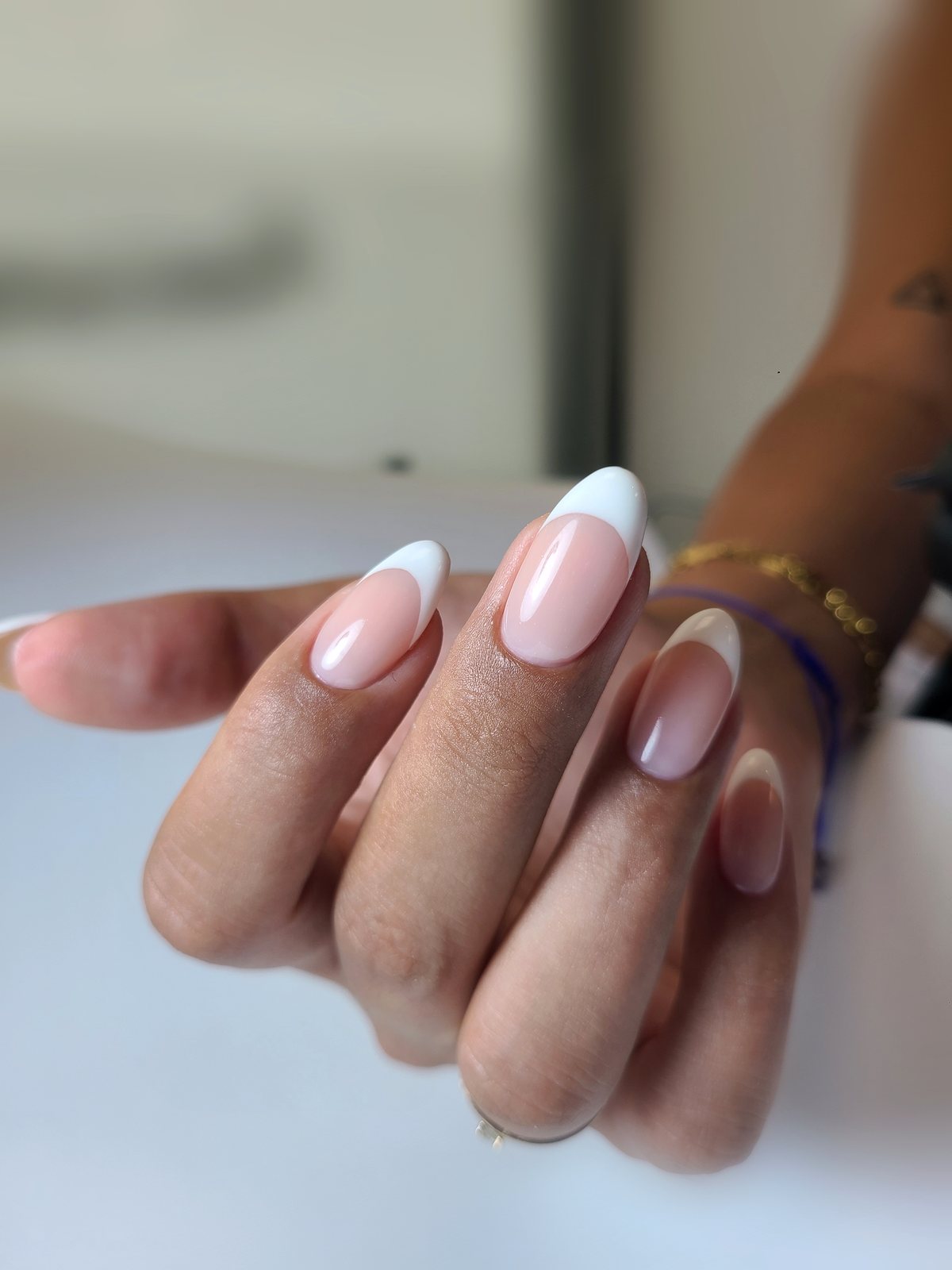
A French manicure is a nail finish with a pale natural or clear base and a contrasting line painted across the tip of the nail — the "smile line". Classic French uses white on a milky base; the same technique in any other colour is still a French.
French nails is simply the everyday name for the same thing. There is no technical difference between the two terms.
It is the most requested finish in most studios and the least forgiving to execute. A solid colour hides a slightly uneven edge. A French line does not — both hands have to match, all ten smile lines have to sit at the same depth, and the curve has to follow the shape of each individual nail.
First, how it is actually priced
This causes more confusion than anything else, so it is worth being direct.
French is not a standalone service. It is a finish added on top of a gel manicure. Studios that advertise only the add-on figure make it look far cheaper than it is.
The real arithmetic is: the gel manicure — which includes full cuticle and pterygium work, shaping, preparation and coating — plus a French finish charge on top. At Private Nail Studio the gel manicure is €45 on short nails or €50 on medium, and the French finish is €5–10, so a French manicure comes to roughly €50–60 in total depending on length and how detailed the line is.
Where you land in that band depends on the work. A classic white smile is at the lower end. A very thin micro-French, a double line, or a contrasting colour needing extra layers to stay opaque sits at the upper end. You should be told which before work starts, not after.
The styles
Classic white
A defined white tip on a milky or clear base. The most recognisable and the most demanding, because white shows every wobble in the line. It works best on medium length, where the curve has room to breathe.
Micro-French
A very narrow line, roughly one to two millimetres. This is the version that suits short nails, and currently the most requested variation overall. It reads as tidy rather than as done, which is exactly why people choose it for work.
Coloured French
Black, red, or a tone matched to something you wear often. Priced the same as classic white. A black micro-French on a clear base is a very common request and photographs particularly well.
Reverse and double
A line at the cuticle instead of the tip, or two lines together. Both sit at the top of the add-on band because they take longer.
Which shape suits French
Square and squoval give the most conventional result. The smile line sits parallel to a straight free edge and is the easiest to make symmetrical across ten nails.
Almond and oval need the line to follow the taper, which makes the curve deeper at the centre. It looks elegant but is harder to match side to side.
Very short nails need a micro line placed close to the free edge. A traditional wide smile on a short nail reads as top-heavy, because the coloured section becomes too large a proportion of visible plate.
If you are between shapes, squoval is the safest for a first French.
Why the line takes as long as it does
Each line is painted freehand. Guides and stickers exist but they cannot follow the individual curve of a nail, and the result usually looks applied rather than drawn.
Freehand means ten individual lines, then comparing both hands side by side and adjusting until they read the same. That comparison step is the one that gets skipped when an appointment is running short, and it is why some French sets look fine on one hand and slightly off on the other.
Bring a photo
"French, but not too thick" describes about forty different outcomes. A single reference image settles it immediately — thickness, depth of curve, base tone, whether the white is bright or milky.
A screenshot on your phone is perfect. Anything in the reference that will not translate to your nail length or shape should be flagged before work starts rather than discovered halfway through.
Care and expectations
- Cuticle oil daily. Reduces lifting at the base, which is where French shows regrowth first.
- Gloves for washing up. The same rule as any gel set.
- Sunscreen on the hands. Strong UV can very slightly warm a bright white tip over three weeks. Subtle, but real in a sunny climate.
- Rebook nearer three weeks than four. Not because the coating fails, but because a French line makes the regrowth gap visually obvious sooner than a solid colour does.
Wear time is the same two to three weeks as any gel manicure. The difference is purely how quickly regrowth becomes noticeable.
Booking
Full pricing and appointment length for the French manicure service in Alicante are on the service page. The underlying gel manicure page covers the base service the French finish is added to.
Frequently asked questions
What is a French manicure?
A nail finish with a pale natural or clear base and a contrasting line painted across the tip — the smile line. Classic French uses white on a milky base, but the same technique in any colour is still a French.
What are French nails?
The same thing as a French manicure. There is no technical difference between the terms; French nails is simply the more common everyday phrasing.
How much does a French manicure cost?
French is a finish added to a gel manicure rather than a standalone service. At Private Nail Studio the gel manicure is €45 short or €50 medium, plus a €5–10 French finish — so roughly €50–60 in total depending on length and detail.
Does French work on short nails?
Yes, with a much thinner line placed close to the free edge. A traditional wide smile on a short nail looks top-heavy because the coloured section becomes too large a proportion of visible plate.
Can the tip be a colour other than white?
Yes, any colour in stock, at the same price as classic white. A black micro-French on a clear base is one of the most requested variations.
How long does a French manicure last?
The same two to three weeks as any gel manicure. The difference is that a French line makes regrowth visually obvious sooner, so many people rebook nearer three weeks for appearance rather than durability.
Bring a reference photo if you have one — a single screenshot settles in seconds what a description often gets wrong. If something will not work on your nail length or shape, I will say so before starting.
Book a French manicureService details and prices: French Manicure in Alicante — prices and booking